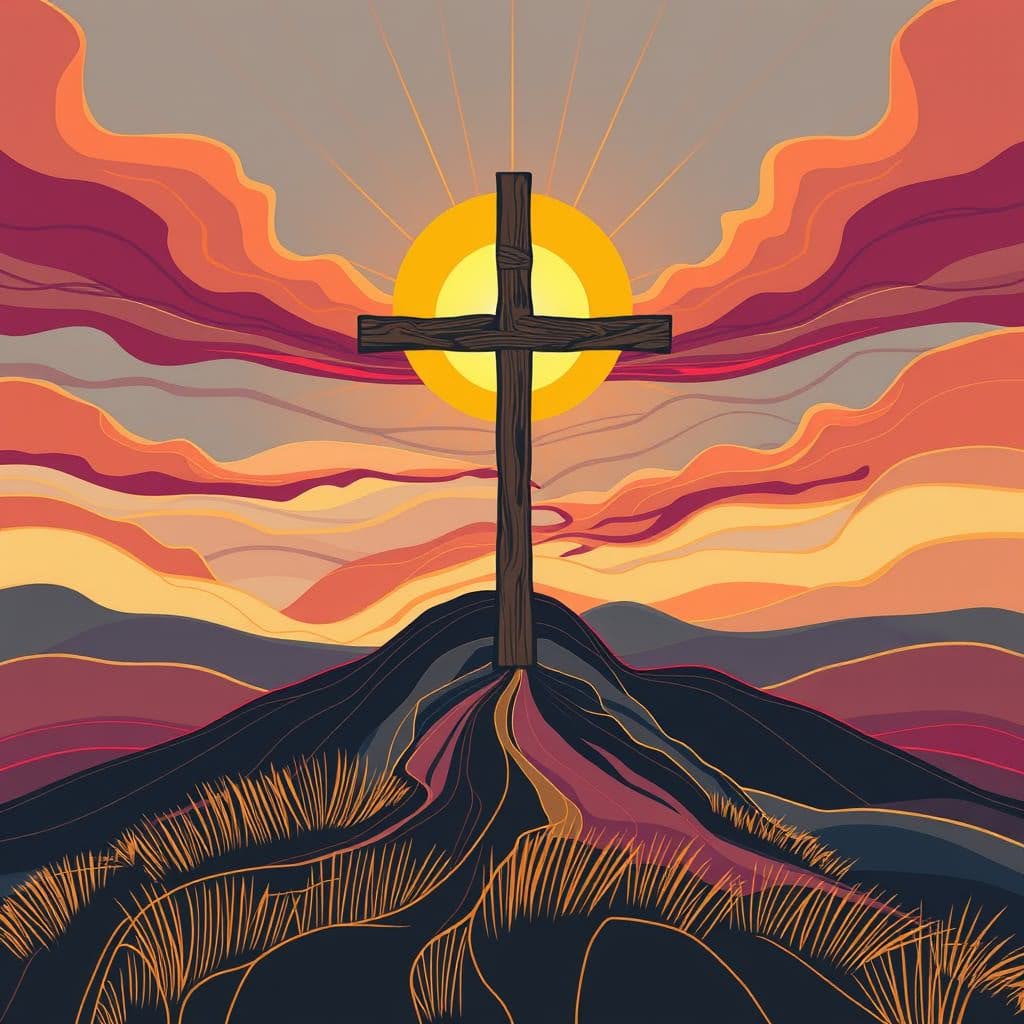
“My God, my God, why have you forsaken me?” Jesus cries out from his anguish, yet incredibly also draws hearers’ attention to the theology of what is taking place.
As I ponder the weekend that we remember Jesus’ sacrifice and celebrate his victory over death, I come back to the question that constantly nags at my brain — what really happened on the cross? I mean, beyond the Christanese language that many of us have grown up hearing. How did this event close the gap between us and God and assure our future with Him?
There’s so much more to it than I can know right now, but my time in the Old Testament has shaped some concepts that make my heart leap with joy and adoration. I want to summarize what I’ve been seeing using a couple representative samples from the books of Hosea and Psalms.
Hosea 2 is a story of the relationship between God and His people, Israel, using the imagery of a husband and wife. In this case, Israel is portrayed as an extremely unfaithful wife. How does a nation commit adultery against a God? By living by the values and practices of other nations with other gods. By putting trust in other things above God, and by assigning credit for His blessing to others.
“For she said, ‘I will go after my lovers, Who give me my bread and my water, My wool and my flax, my oil and my drink…Yet she does not know that it was I myself who gave her the grain, the new wine, and the oil, And lavished on her silver and gold, Which they used for Baal.” (Hosea 2:5, 8)
God’s response is to add clarity to confusion. His bride is on a destructive path, misguided about where true security and joy lies. In his compassion, He makes the dangerous way more difficult, opening her eyes to the effects of Sin.
“Therefore, behold, I will obstruct her way with thorns, And I will build a stone wall against her so that she cannot find her paths. “And she will pursue her lovers, but she will not reach them; And she will seek them, but will not find them. Then she will say, ‘I will go back to my first husband, because it was better for me then than now!” (Hosea 2:6-7)
Punishment language is used, but if you examine the story, the punishment isn’t the point. It is a tool of redirection, which leads her to notice Him wooing her back. The reunion that happens next is not because a score was properly settled, or a due penalty applied. It happens because of a change of heart following a change of understanding.
“Therefore, behold, I am going to persuade her, Bring her into the wilderness, And speak kindly to her. “Then I will give her her vineyards from there, And the Valley of Achor as a door of hope. And she will respond there as in the days of her youth, As in the day when she went up from the land of Egypt. “And it will come about on that day,” declares the Lord , “That you will call Me my husband And no longer call Me my Baal.” (Hosea 2:14-16)
A restored forever relationship is what He seeks and accomplishes, and He does it by revealing his righteousness, justice, compassion, and faithfulness. When we experience those attributes in Him, it is then that we know the Lord.
“I will betroth you to Me forever; Yes, I will betroth you to Me in righteousness and in justice, in favor and in compassion, And I will betroth you to Me in faithfulness. Then you will know the Lord.”(Hosea 2:19-20)
Not only do His own people recognize these things in Him, but His love expands to include all who had not experienced compassion or being called His. A great portion of the New Testament, by the way, is devoted to helping the descendants of Israel understand how the outsiders could be called Israel, too.
“I will sow her for Myself in the land. I will also have compassion on her who had not obtained compassion, And I will say to those who were not My people, ‘You are My people!’ And they will say, ‘ You are my God!'” (Hosea 2:23)
The themes in this story are widely repeated throughout the Old Testament. God is constantly working to rescue victims, even self-made ones, and to reveal His goodness to people’s understanding. We seem to be violator-focused in our ideas of justice – so-and-so needs to be punished! God seems to be victim-oriented in His justice; He wants to do the right thing by healing, restoring, liberating, and by separating evil from us. He wants to be known and to return to the intimacy of a trusting, loving relationship He created us to be in.
Let’s now look at Psalm 22, the chapter opening of which Jesus quoted on the cross. If the Bible is one great story leading up to the cross, then God had all of scripture to communicate what the cross would be about. He had all of scripture to describe how much we owed Him and how important it was to Him that He got His payment. He had all of scripture to describe how eager He has been for our sins to be punished. My journey is simply not catching this vibe. What I see is a love pursuit begging for relational restoration. It’s not a mushy and weakly-whispered sentiment, but a passionate and powerful love that does not compromise or hold back or sidestep pain. While collecting His thoughts for His final words, Jesus had a stage etched in history from which to point us to any scene explaining what He was doing. He chose Psalm 22. What does that chapter describe?
Firstly, it describes that Jesus felt desperately alone in a way He hadn’t felt before. He is in anguish, yet he paints an incredible picture of a God who is holy and good. He remembers from history what His people experienced when they trusted the Lord.
“In You our fathers trusted; They trusted and You rescued them. To You they cried out and they fled to safety; In You they trusted and were not disappointed.” (Psalm 22:4-5)
Next, Jesus describes, through reference to the Psalm, the dire circumstances he is in — despised, disgraced, sneered at — and the way they tempt him to give up and rescue himself. They press him, as the world does, to turn way from his trust in the Father, and to take matters into his own hands. But Jesus refuses to do that. He’s trusted the Father since his birth and he does not want to stop now, even though he is wrecked.
“Turn him over to the Lord ; let Him save him; Let Him rescue him, because He delights in him. Yet You are He who brought me forth from the womb; You made me trust when upon my mother’s breasts. I was cast upon You from birth; You have been my God from my mother’s womb. Do not be far from me, for trouble is near; For there is no one to help… I am poured out like water, and all my bones are out of joint; my heart is like wax; It is melted within me. My strength is dried up like a piece of pottery, And my tongue clings to my jaws; And You lay me in the dust of death. For dogs have surrounded me; A band of evildoers has encompassed me; They pierced my hands and my feet. I can count all my bones. They look, they stare at me; They divide my garments among them, And they cast lots for my clothing.” (Psalm 22:8-11,14-18)
Again, Jesus calls to the Father to be near, to save, because Jesus has an objective:
“I will proclaim Your name to my brothers; In the midst of the assembly I will praise You.” (Psalm 22:22)
Here is the unspoken conversation my mind sees taking place on the cross. Suspended by the nails of some of the worst torture devised by men of the time, Jesus conveys, “Look. Look at me. I understand your pain. I understand your fear. I get why you scramble for power and security, but look. God is enough. He’s getting me through this. He can get you though your thing. Trust Him.”
And furthermore, “I and the Father are one. I am human like you; I have laid down my divine power to also show you that the Father is not out to get you. You are crucifying the very Son of God, and neither of us are fighting you back. If this doesn’t show you that I’m dead serious about loving you, then nothing will. Nothing can separate my love from you! If this doesn’t show you where the Sin-driven, self-reliant, pride-bound thirst for control that plagues humanity leads, then nothing will.”
He continues, “I know Satan has had you bound in helplessness to your own fallen nature all this time, because Adam handed over man’s regency through an act of deference to the enemy’s lies. You’ve never been the same since. I have come to free you. I have stepped in as a man to live a life of righteousness and to reclaim authority over the earth for the kingdom of God. I know this means I have to die. Though my commitment to you is sure, and my righteousness unfailing, I know that if I didn’t lay down my life, Satan would use any days remaining to claim that he could’ve made me fail. But I will not fail you. I will be faithful to the end. I will pay this price upon myself for you to know the Lord. I have been wrongfully accused and treated like a criminal, but you must know how far I will go for you. And you need to see how far Satan will go to destroy. Look at Me. Know Me. Trust Me. If you listen to Me and not the enemy, I can save you by my power and righteousness, and adopt you as heirs to my kingdom. Satan will have a say over earth no more, for you are Mine.”
This is the identity and work of God that Jesus proclaims to his brothers and sisters while on the cross. Jesus did not come to condemn the afflicted, but to share in our experience so that we can share in His. Not until all was and is revealed about the extent of God’s love and of Satan’s wickedness, can God destroy Sin forever, else we would think Him a monster and flee. By subjecting himself to our pride, he has opened our eyes. He knows that this weekend will be remembered forever. The true identity and saving power of God will be spoken of to every generation until the end of time. His righteousness will be known and bestowed throughout the earth. Psalm 22 cries, “Put your trust in the Lord!”
As Jesus’ breathes, “It is finished,” the Psalm ends with “He has done it!” Done what? Revealed the fullness of God’s love. Captivated our attention to the reality of suffering and hope before and around us, demonstrating for all time that there is no better place to go than in the arms of our First Love.
 S.A.H.M. Hill